




Greece offers financially independent non-EU nationals a 3-year residence permit without an investment. Applicants qualify with passive income of at least €3,500 a month or €126,000 in savings and may include close family members.
This guide explains how Greece FIP residence works in 2026, from financial requirements and application costs to taxes, renewal, permanent residence, and the route to citizenship.
What is Greece residence for financially independent persons?
Greece residence for financially independent persons is a temporary residence permit for non-EU nationals who can support themselves without working in Greece. The permit is issued for 3 years and may be renewed if the holder continues to meet the financial, insurance, accommodation, and residence requirements[1]Source: Official Government Gazette of Greece.
Key features of Greece residency for FIP include:
- 3-year residence permit with the possibility of renewal;
- €3,500+ monthly passive income or €126,000 in savings;
- 183+ days of residence in Greece per year;
- family inclusion for a spouse and children under 18;
- no right to employment or active business activity in Greece;
- property rental or purchase required to confirm accommodation in the country.
Obtaining Greece residence for financially independent persons takes at least 4 months. The first permit may be renewed if the holder continues to meet the financial and residence conditions.
Trusted by 10,000+ investors
Check your eligibility for the Greece Golden Visa
Who qualifies for Greece FIP residence?
Greece residence for financially independent persons is available to non-EU nationals who can support themselves without employment or business activity in Greece. Applicants need sufficient passive income or savings, suitable accommodation, and health insurance for the residence period[2]Source: Official Government Gazette of Greece.
Eligibility requirements
The main applicant must:
- be over 18;
- hold a valid passport;
- have no criminal record;
- obtain health insurance;
- rent or buy accommodation in Greece;
- prove sufficient passive income or savings;
- be prepared to spend at least 183 days a year in Greece.
The residence permit does not authorise employment or active business activity in Greece. The applicant’s income therefore needs to come from sources outside the country.
Financial requirements
The main applicant must prove at least €3,500 per month in stable passive income. Acceptable sources may include pensions, rental income, dividends, and interest on deposits.
Applicants may use savings instead of regular income. The minimum amount is €126,000 for the main applicant, equivalent to 3 years of the required monthly income.
A spouse and children under 18 may obtain residence together with the main applicant. Their permits depend on the main applicant continuing to meet the FIP requirements. The financial requirement increases by 20% for a spouse and 15% for each child.
How much does Greece residence for FIP cost?
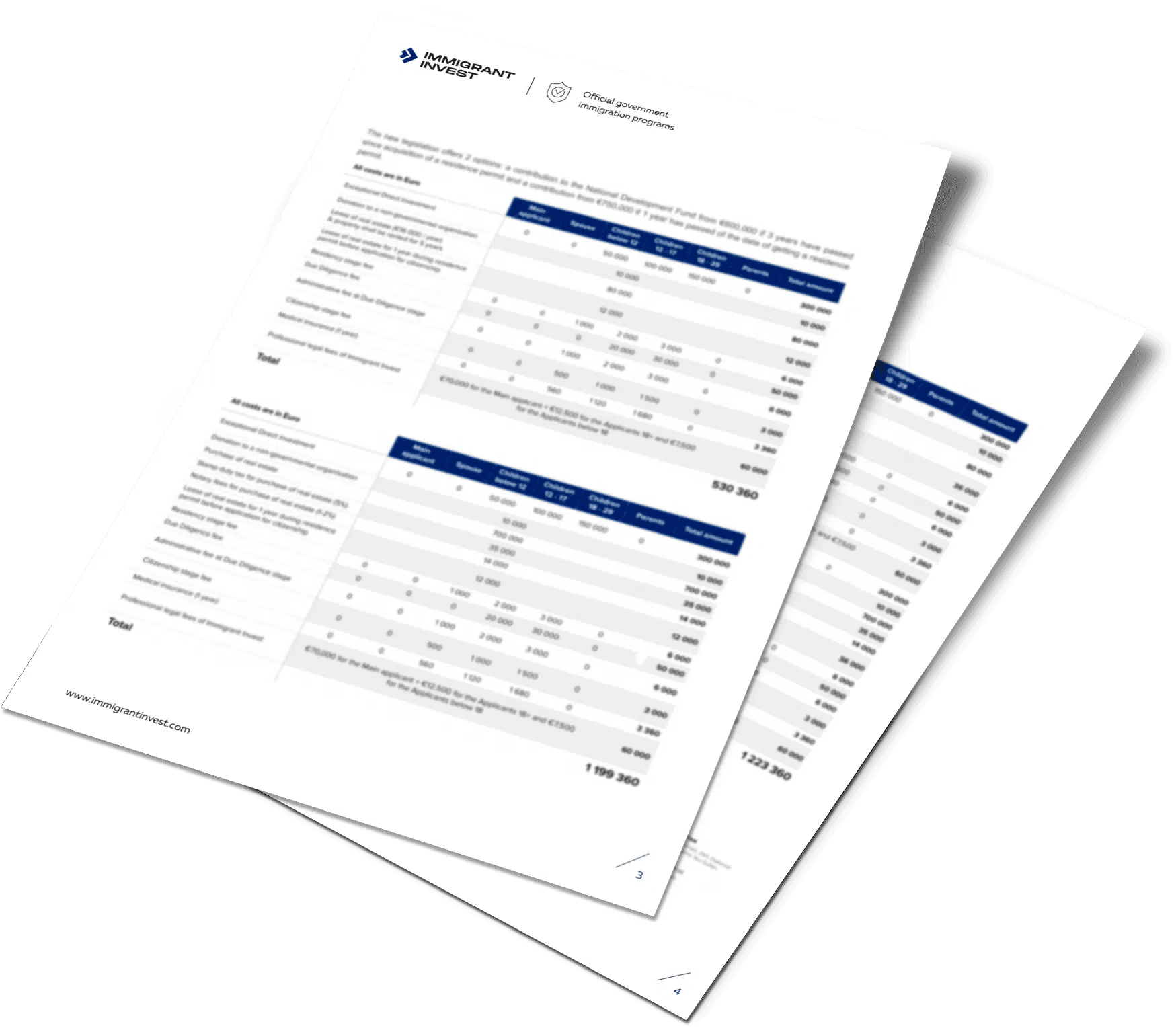
The cost of Greece residence for financially independent persons depends mainly on family composition and whether the applicant proves regular passive income or savings. Property, insurance, government fees, and document preparation create additional expenses.
The main applicant needs either €3,500+ in monthly passive income or €126,000+ in savings. The financial requirement increases by 20% for a spouse and 15% for each child.
Main expenses
Applicants also budget for:
- €180 — Type D visa consular fee per applicant;
- €1,000 — residence permit application fee for the main applicant;
- €150 — residence permit application fee for each family member;
- €16 — residence permit card issuance per applicant;
- around €700 a year — health insurance per applicant;
- around €50 — medical certificate per applicant;
- €1,000+ — document preparation and processing.
Housing is a separate expense
Applicants may rent or buy a home, as the FIP route does not set a minimum property purchase price. Housing costs vary significantly by city, location, and apartment size.
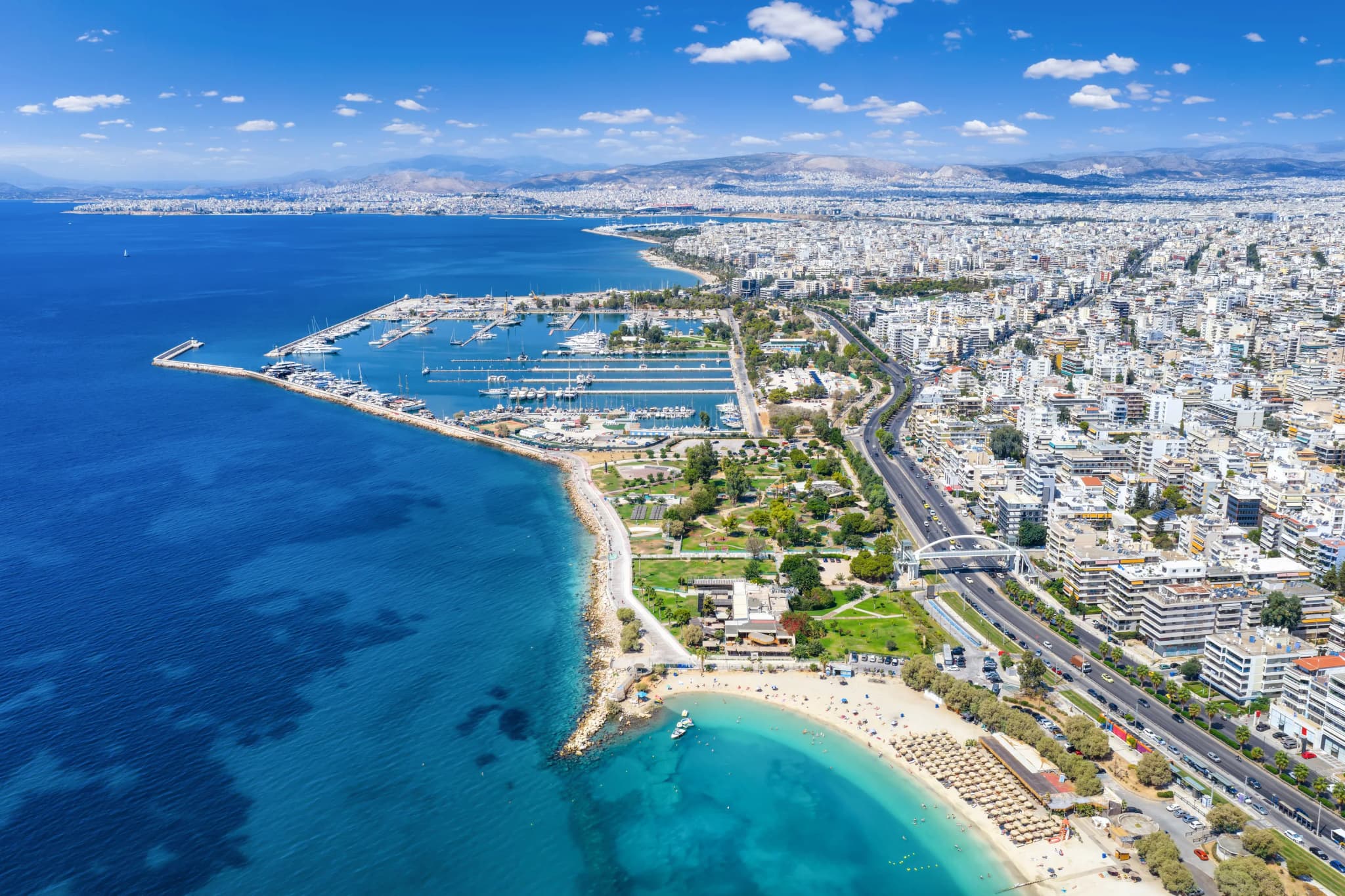
For example, in Athens, a one-bedroom apartment for one person rents for around €575—665 per month, depending on whether it is outside or inside the city centre. A three-bedroom apartment suitable for a family costs around €1,040—1,160 per month.
Purchase prices average about €3,070 per m² outside central Athens and €3,595 per m² in the city centre. At these rates, a 50 m² apartment for one person may cost approximately €154,000—180,000, while a 100 m² family apartment may cost around €307,000—360,000[3]Source: Numbeo — Property prices in Athens.
These figures are indicative. The table below excludes housing and document-related expenses because the final amount depends on the chosen property and the applicant’s circumstances.
Cost comparison: passive income vs savings

What documents are required for Greece FIP residence?
Applicants for Greece residence for financially independent persons first obtain a national Type D visa and then apply for a residence permit in Greece. The file usually includes identity documents, proof of passive income or savings, accommodation documents, health insurance, and papers confirming the legal origin of funds.
Immigrant Invest lawyers help collect and prepare the required documents, arrange translations and apostilles where needed, and check the file before submission. This reduces the risk of delays caused by incomplete or incorrectly prepared papers.
Greece FIP residence document checklist
Application readiness
0/12
Early stage. Core documents are still missing, so the application file is not yet ready for submission.
Get an individual document list compiled for your specific situation, so nothing gets missed before application submission
How to obtain Greece residence for FIP
Based on the experience of Immigrant Invest lawyers, obtaining Greece residence for financially independent persons takes at least 4 months. The applicant first prepares the documents and obtains a national Type D visa, then enters Greece and applies for the residence permit.
The process may take longer if the authorities request additional documents or if translations, legalisation, or property arrangements require extra time.
1 day
Complete Preliminary Due Diligence
The Immigrant Invest Compliance Department checks the applicant against international databases before signing an agreement. The review helps identify potential risks before the residence process starts.
The Immigrant Invest Compliance Department checks the applicant against international databases before signing an agreement. The review helps identify potential risks before the residence process starts.
2+ weeks
Prepare documents and obtain an AFM
Lawyers prepare a personalised document list and application forms. The applicant also obtains an AFM, the Greek tax identification number used for tax and financial procedures in Greece.
Lawyers prepare a personalised document list and application forms. The applicant also obtains an AFM, the Greek tax identification number used for tax and financial procedures in Greece.
≈ 1.5 weeks
Obtain a Type D national visa
The applicant submits the visa application to a Greek consulate in their country of citizenship or legal residence. The file includes a passport, proof of financial means, criminal record certificate, health insurance, and other supporting documents.
The applicant submits the visa application to a Greek consulate in their country of citizenship or legal residence. The file includes a passport, proof of financial means, criminal record certificate, health insurance, and other supporting documents.
2+ weeks
Rent or buy accommodation in Greece
The applicant needs to confirm a residential address before filing for residence. Buying property is optional, as a registered rental agreement is sufficient.
The applicant needs to confirm a residential address before filing for residence. Buying property is optional, as a registered rental agreement is sufficient.
1 day
Submit the residence application and biometrics
The applicant files the residence permit application in Greece and submits biometrics. A temporary filing certificate confirms legal stay while the application is being processed.
The applicant files the residence permit application in Greece and submits biometrics. A temporary filing certificate confirms legal stay while the application is being processed.
≈ 3 months
Receive the residence permit card
After approval, the applicant receives a residence permit valid for 3 years. The status can be renewed if the holder continues to meet the applicable requirements.
After approval, the applicant receives a residence permit valid for 3 years. The status can be renewed if the holder continues to meet the applicable requirements.
How to keep and renew Greece FIP residence
Before extending Greece residency for FIP, the authorities check whether the holder still meets the conditions on financial means, residence in Greece, insurance, and compliance with tax and immigration rules.
The permit is renewed for another 3 years if these conditions continue to be met[4]Source: Official Government Gazette of Greece — Law No. 5038.
What authorities check at renewal
The holder needs to confirm several points:
- physical presence in Greece: at least 183 days a year;
- financial means: €3,500+ in monthly passive income or sufficient savings;
- valid health insurance for the new residence period;
- accommodation in Greece, confirmed by ownership or rental documents;
- tax compliance, including the absence of outstanding liabilities;
- lawful residence history without serious immigration violations.
For family applications, the higher financial requirement continues to apply at renewal: 20% more for a spouse and 15% more for each child.
When to apply for renewal
The application is best filed before the current card expires. Greek law also allows submission within 3 months after expiry, but late filing results in a €100 fine for each month of delay[5]Source: Official Government Gazette of Greece — Law No. 5275 on Legal Migration Policy.
Applicants submit an updated set of supporting documents rather than simply extending the existing card. This usually includes the passport, current residence permit, proof of financial means, insurance, accommodation documents, and payment receipts.
Renewal expenses
The main government and related costs include:
- €1,000 — renewal fee for the main applicant;
- €150 — for each family member over 18;
- €16 — new residence card per applicant;
- around €700 per year — health insurance per person.
Translation, certification, and updated rental documents may increase the final cost.
Benefits and restrictions of Greece residence for FIP
Greece residence for financially independent persons provides more than the right to live in the country. Holders can travel within the Schengen Area, relocate with family members, rent or purchase property, and use local banking and education services.
1. Travel within the Schengen Area
Greece FIP residence holders can travel to other Schengen countries without obtaining a separate short-stay visa. Under Schengen rules, stays outside Greece are limited to 90 days within any 180-day period [6]Source: EUR-Lex — Schengen Borders Code.
The residence permit remains the basis for long-term stay in Greece. Time spent in other Schengen countries does not replace the requirement for FIP holders to reside in Greece for at least 183 days a year.
2. Relocate with a spouse and children
The main applicant can obtain Greek residence together with a spouse and children under 18. Family members receive their own residence permits linked to the principal applicant’s status.
Adding family members increases the financial requirement. The required passive income rises by 20% for a spouse and 15% for each child. For example, a couple needs at least €4,200 per month, while a couple with 2 children needs €5,250[1]Source: Official Government Gazette of Greece.
3. Rent instead of buying property
Greece residency for FIP does not require a real estate investment. Applicants only need to prove they have accommodation in Greece and can either rent or buy a property. There is no minimum property purchase price under the FIP route.
In comparison, the Greece Golden Visa requires applicants to invest at least €250,000 in property[7]Source: Greece Ministry of Migration and Asylum.
4. Open a bank account and obtain an AFM
FIP residents can open accounts with Greek banks. Applicants normally obtain an AFM, the Greek tax identification number, during the residence process and use it for financial and tax transactions in Greece.
Foreigners can request an AFM electronically. Identification can then be completed either in person at a tax office or remotely by videoconference[8]Source: Gov.gr — Attribution of Tax Identification Number.
5. Enrol children in Greek schools
Children of third-country nationals living in Greece have access to compulsory education under the same conditions as Greek children. They can participate in school and educational activities regardless of nationality[9]Source: Greek Ministry of Education — Education of migrants and refugees.

Elena Ruda,
Co-Founder & Managing Partner
Greece FIP residence does not grant the right to take employment or actively conduct business in the country. The holder is expected to support themselves through passive income or savings from outside Greece.
FIP holders also need to spend at least 183 days a year in Greece to maintain the status. This level of physical presence normally makes them Greek tax residents, so their worldwide income becomes relevant for Greek taxation[10]Source: Independent Authority for Public Revenue — Tax residence for natural persons.
Greece FIP residence compared with other passive-income residence routes
Several EU countries offer residence options for foreigners who can support themselves without relying on local employment. Greece, Portugal, Spain, and Italy follow this general model, but their financial thresholds, work restrictions, and initial residence periods differ.
Greece FIP permit sets the highest stated monthly income threshold among these four routes. The main applicant needs €3,500 per month, but Greece also allows financial eligibility to be demonstrated with at least €126,000 in savings. Greece FIP residence is issued for 3 years and does not permit employment in the country[1]Source: Official Government Gazette of Greece.
Portugal D7 Visa is intended for retirees and foreigners living on their own income. The financial benchmark is equal to the Portuguese minimum wage, which is €920 per month in 2026.
Temporary residence permits are issued for 2 years, and Portuguese law gives residence permit holders access to employed and self-employed work[11]Source: AIMA — Rights of residence permit holders.
Spain Non-Lucrative Visa requires a passive income of at least €2,400 per month or €28,800 per year. The visa does not authorise employment or professional activity in Spain[12]Source: Spanish Ministry of Foreign Affairs — Non-working residence visa.
Italy’s Elective Residence Visa targets foreigners planning to settle in Italy using stable passive resources. It requires at least €31,000 a year for one applicant and excludes income from employment.
Applicants also prove accommodation in Italy, either through ownership or a rental agreement[13]Source: Italian Embassy — Elective Residence Visa.
Comparison of Greek, Portuguese, Spanish, and Italian passive income visas
Taxes for Greece FIP residence holders
Greece FIP residence requires substantial physical presence in the country. A person who spends more than 183 days in Greece during any 12-month period becomes a Greek tax resident from the first day of their presence.
Tax residency may also arise through a permanent or principal home, habitual residence, or centre of vital interests in Greece[14]Source: Independent Authority for Public Revenue — Tax residence for natural persons.
Greek tax residents declare their worldwide income, including income received abroad. Foreign tax paid on the same income may be credited against Greek tax if there is a double taxation agreement in place[15]Source: Independent Authority for Public Revenue — Taxation of foreign-source income.
Taxes on passive income
The FIP route is based primarily on passive income, so investment and property taxation is particularly relevant. Standard Greek rates include:
- 5% on dividends;
- 15% on interest;
- 20% on royalties;
- 15% on qualifying capital gains from securities and other financial assets;
- 15—45% on rental income under the progressive property income scale[16]Source: Independent Authority for Public Revenue — Income categories and taxation.
7% tax regime for foreign pensioners
Foreign pensioners, including FIP permit holders, who transfer their tax residence to Greece may qualify for the special regime under Article 5B of the Income Tax Code[17]Source: Independent Authority for Public Revenue — Tax incentives for new tax residents.
To qualify, an applicant must:
- receive pension income from abroad;
- not have been a Greek tax resident for at least 5 of the previous 6 years;
- transfer tax residence from a country that has an administrative tax cooperation agreement with Greece;
- submit a separate application for the tax regime.
The Article 5B regime is separate from Greece residence for FIP. Receiving an FIP permit does not automatically grant the 7% tax treatment[18]Source: Independent Authority for Public Revenue — Tax incentives for new tax residents.
Greece FIP residence vs Greece Golden Visa
Greece offers two residence routes for people who can support themselves without taking local employment. Greece FIP residence is based on passive income or savings, while the Golden Visa requires a qualifying investment. The routes also differ in permit validity, physical presence, family inclusion, and tax consequences.
Greece FIP residence requires actual relocation. Spending at least 183 days a year in Greece normally makes the holder a Greek tax resident and brings worldwide income within the Greek tax system[14]Source: Independent Authority for Public Revenue — Tax residence for natural persons.
The Golden Visa does not require the investor to live permanently in Greece. Real estate routes currently start at €250,000 for listed buildings or properties converted to residential use, while other property categories may require €400,000 or €800,000 depending on location[19]Source: National Registry of Administrative Public Services — Golden Visa for listed property.
Switching between Greece FIP residence and the Golden Visa
Changing routes is not an automatic conversion of the existing permit. A resident who meets the conditions for another residence category submits an application under the new basis and provides the required supporting documents.
Golden Visa applications can also be submitted digitally by third-country nationals who already hold a valid Greek residence permit, so leaving Greece solely to file the new application is not required[20]Source: Greece Ministry of Migration and Asylum — Residence permit categories.
A switch also changes the conditions the holder must maintain. For example, moving from FIP residence to the Golden Visa removes the FIP income basis and 183-day residence requirement, while moving in the opposite direction requires the applicant to meet the FIP financial and physical-presence conditions.
Key differences between Greece FIP residence and the Golden Visa
Can Greece FIP residence lead to permanent residence and citizenship?
After 5 years of legal and continuous residence, FIP holders may qualify for permanent residence.
Naturalisation is possible after completing 7 years of lawful residence in Greece, although there are some peculiarities[21]Source: Greek Ministry of Interior — Greek Citizenship Code.
Permanent residence after 5 years
FIP residence can count towards the 5 years of legal and continuous residence required for EU long-term resident status in Greece. However, completing 5 years under the FIP route does not grant permanent residence automatically.
Applicants submit a separate application and need to meet additional conditions. These include:
- stable financial resources;
- full health insurance;
- evidence of integration into Greek society.
Integration may be demonstrated through sufficient knowledge of the Greek language and elements of Greek history and culture[22]Source: Greek Migration Code — Article 145.
Continuity of residence also matters. During the 5-year period, absences generally must not exceed 6 consecutive months or 10 months in total[23]Source: Greek Council for Refugees — Long-term residence.
Citizenship after long-term residence
FIP holders can eventually apply for Greek citizenship, but the required residence period depends on the status they hold at the time of application.
One option is to obtain EU long-term resident status after 5 years of legal and continuous residence in Greece. This status is included among the residence titles eligible for the standard naturalisation route. Once the applicant has completed 7 consecutive years of legal residence in total, they may apply for citizenship, provided they meet the other naturalisation requirements.
If the applicant remains on an FIP residence permit instead, the standard 7-year rule does not apply. Holders of other valid residence titles not included in the qualifying list may apply after 12 consecutive years of legal residence[21]Source: Greek Ministry of Interior — Greek Citizenship Code.
Naturalisation requirements
Applicants need to demonstrate integration into Greek society and pass the Certificate of Knowledge Adequacy for Naturalisation examination.
The exam assesses:
- Greek language skills at approximately B1 level;
- Greek history and geography;
- Greek culture;
- country’s political institutions.
Applicants need a 70% overall score, subject to the minimum scores set for the language and knowledge sections[21]Source: Greek Ministry of Interior — Greek Citizenship Code.
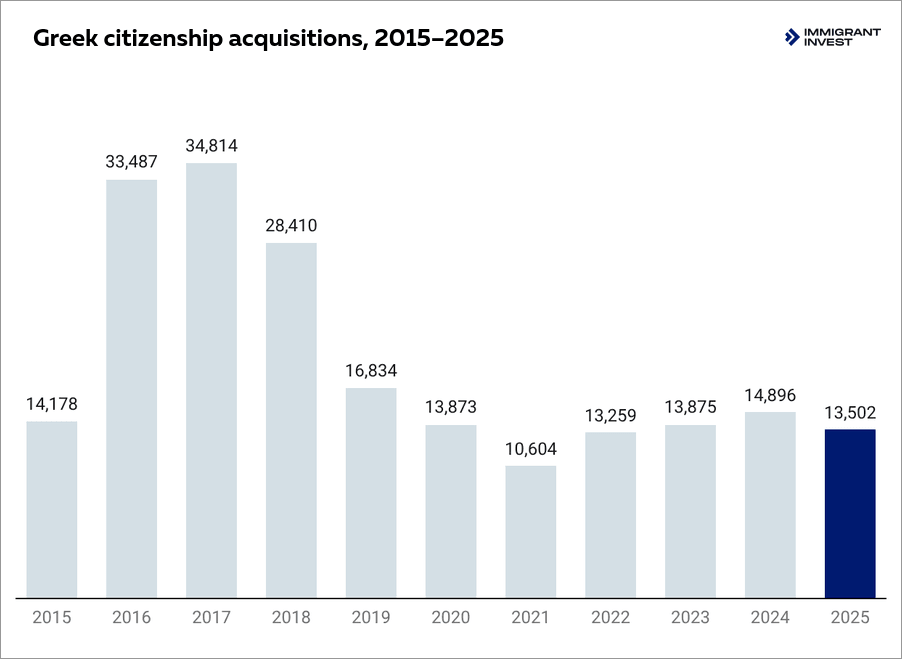
The rise in 2016 and 2017 was driven by the new law, which allowed second-generation immigrants born or educated in Greece to get citizenship
Risks that may affect Greece FIP residence or renewal
Greece FIP residence depends on the holder continuing to meet the programme conditions after the first permit is issued. Changes in residence, income, insurance, or legal status can therefore affect the next renewal.
Insufficient time spent in Greece
FIP holders need to spend at least 183 days a year in Greece. Falling below this threshold may prevent the holder from demonstrating the residence required for renewal[4]Source: Official Government Gazette of Greece — Law No. 5038.
Applicants should therefore keep evidence of their presence in Greece, including travel records and other documents that may be requested during renewal.
Loss of qualifying income or savings
The financial requirement applies not only to the initial application. At renewal, the main applicant needs to continue proving at least €3,500 per month in passive income or €126,000 in savings for the next 3-year residence period.
A significant fall in passive income can therefore affect both the main applicant and family members whose permits depend on the principal holder’s status.
Employment or active business activity in Greece
Greece FIP residence is designed for people who support themselves without local employment. Holders cannot work as employees or actively conduct business in Greece under this residence category[4]Source: Official Government Gazette of Greece — Law No. 5038.
Receiving passive investment or property income is different from actively working or managing a business. Applicants whose circumstances change may need to consider another residence category rather than continue under the FIP route.
Insurance, tax, and accommodation issues
Renewal also requires the holder to maintain valid health insurance and suitable accommodation in Greece. Outstanding tax liabilities or incomplete supporting documents can create additional problems during the renewal process.
Applicants who rent their home should also check that the lease remains valid and properly documented when preparing the renewal file.
Late renewal application
A residence permit should be renewed before it expires. Greek law allows an application to be submitted within 3 months after expiry, but a late application results in a €100 fine for each month of delay[5]Source: Official Government Gazette of Greece — Law No. 5275 on Legal Migration Policy.
How Immigrant Invest helps with Greece FIP residence
Immigrant Invest supports applicants throughout the Greece FIP residence process, from checking eligibility to preparing the residence permit application. The team also helps identify issues with financial documents, source of funds, and accommodation before submission.
Assess eligibility before applying
The process starts with a preliminary Due Diligence check. Compliance specialists review the applicant’s background, financial profile, and source of funds to identify potential issues before documents are submitted.
At this stage, lawyers also assess whether the applicant meets the €3,500 monthly income requirement or should use savings as proof of financial means.
Prepare documents and calculate costs
Immigrant Invest helps assemble the required documents, arrange translations and legalisation, and prepare evidence of income, savings, insurance, and accommodation.
Applicants also receive an estimate of government fees and other expenses before starting the procedure.
Coordinate the application in Greece
The team assists with obtaining an AFM, preparing the Type D visa application, arranging accommodation, and filing for the residence permit. Applicants are informed in advance when their personal presence is required.
Support can continue after the first permit is issued, including preparation for renewal and checking that the applicant continues to meet the residence and financial requirements.
Key points about Greece residence for financially independent persons
- Greece FIP residence is issued for 3 years. The main applicant needs at least €3,500 per month in passive income.
- Savings may replace regular passive income. For one applicant, the benchmark is €126,000. The financial requirement rises by 20% for a spouse and 15% for each child.
- FIP holders need to spend at least 183 days a year in the country to maintain the conditions for renewal.
- Employment is not permitted. The programme is intended for applicants who support themselves with passive income or savings rather than work in Greece.
- Buying property is not required. Applicants may rent a home instead. This distinguishes FIP residence from the real estate option under the Greece Golden Visa.
- The permit is renewable. The holder needs to continue meeting the financial, residence, insurance, and other applicable requirements at each renewal.
Immigrant Invest is a licensed agent for citizenship and residence by investment programs in the EU, the Caribbean, Asia, and the Middle East. Take advantage of our global 15-year expertise — schedule a meeting with our investment programs experts.
 Trusted by 10,000+ investors