







For many foreigners, Greece is already a good place to live thanks to its sizeable international community. Around 1 million third-country nationals and roughly 300,000 EU citizens reside in the country, together accounting for just over 11% of the population.
Living in Greece offers lifestyle advantages, such as a mild climate, moderate living costs, and a slower pace of everyday life.
In this guide, we take a closer look at what life in Greece involves, including residence options, expenses, and key factors to consider before moving.
Is Greece a nice place to live?
Greece is a pleasant place to live, especially if you value climate, sea access, fresh food and a slower daily rhythm. Life often feels more relaxed than in many large countries in the European Union, and that is one of the main reasons expats in Greece choose to stay long-term.
For retirees, the main advantages are a mild climate, a slower pace of life, and lower day-to-day costs in many areas outside the main tourist hotspots.
For families, the key considerations are international schools, healthcare, safety, and reliable year-round infrastructure.
For digital nomads, Greece offers warm weather, sea access, and established bases for remote work in Athens, Thessaloniki, Crete, and on the islands.
For investors, Greece combines personal financial interests with long-term planning. They may spend part of the year in the country, relocate with family, and hold a qualifying asset at the same time.
The Greece Golden Visa allows eligible non-EU nationals to obtain a residence permit through qualifying investments, including real estate. The permit is issued for five years and can be renewed if the investment is maintained. Family members may also obtain residence permits, and private health insurance is required both for the initial application and for renewal.

Trusted by 10,000+ investors
Check your eligibility for the Greece Golden Visa
10 benefits for expats living in Greece
Greece attracts expats for a combination of lifestyle, cost factors, and residence options. The advantages below reflect both everyday experience and structural benefits, from lower living expenses to tax incentives and residence pathways.
1. Lower cost of living than Western Europe
Greece remains more affordable than many countries in the European Union. According to Numbeo, overall consumer prices in Greece are significantly lower than in Western European capitals, particularly for groceries, dining, and local services.
This difference is most noticeable for expats with income from abroad. Those earning in euros, dollars, or pounds often find that everyday expenses take a smaller share of their budget, especially outside central Athens and high-demand islands.
Average expenses in Greece, Portugal, and the US
Source: Numbeo.com
2. Affordable housing
Property prices and rents in Greece are generally lower than in major European cities. For example, monthly rent for a one-bedroom apartment in the city centre is about €678 in Athens and €590 in Thessaloniki. A three-bedroom apartment costs around €1,230 in Athens and €978 in Thessaloniki[1].
Long-term rentals in non-tourist zones are cheaper, with one-bedroom flats outside the centre averaging about €518 in Athens and €429 in Thessaloniki. According to Bank of Greece data, prices have been rising, but remain below pre-2008 peak levels in many regions. For expats, this creates a wider range of options, from city apartments to coastal homes.
3. Access to the sea and diverse locations
Greece has more than 13,000 kilometres of coastline and over 2,000 islands, offering a wide range of living environments, from large cities to small coastal towns.
This diversity allows expats to choose a lifestyle that matches their priorities. Some prefer year-round living in Athens or Thessaloniki, while others choose islands like Crete or Corfu, where infrastructure supports both permanent residents and seasonal demand.
4. High level of life expectancy
In larger cities, private clinics and international-standard hospitals are common. Many expats choose private insurance, which is typically more affordable than in countries like the UK or the US, especially for routine care and specialist appointments.
Life expectancy in Greece reached about 82.4 years in 2025, slightly above the EU average. Globally, the country ranks around 30th out of nearly 200, with approximately 84.7 years for women and 80 for men. This reflects both lifestyle factors and access to medical services, contributing to the perception of Greece as a nice place to live.
5. Established expat community
Greece has a well-established foreign population, including both EU citizens and third-country nationals. According to Eurostat data, as of January 1st, 2024, around 913,400 third-country nationals and 234,400 EU citizens were living in Greece, representing more than 1.1 million foreign residents in total[2].
For newcomers, this reduces the barrier to entry. In larger cities and popular regions, it is easier to find international schools, English-speaking services, and communities of expats already familiar with local processes.
6. Strong food culture and local produce
Greece is known for its Mediterranean diet, which is based on fresh vegetables, olive oil, fish, and seasonal ingredients. This is not limited to restaurants: local markets operate regularly in most areas, offering fresh products directly from producers.
For expats, this affects both lifestyle and spending habits. Cooking at home with local ingredients can be more affordable than in many EU countries, while the quality of food remains consistently high across regions.
7. Work-life balance and slower pace of life
Compared to Northern and Western Europe, daily life in Greece tends to be less structured and more focused on social interaction, outdoor activities, and family time.
For many expats, this is one of the main reasons to relocate. The pace of life can reduce stress, although it may also require adjustment for those used to more fast-paced and highly organised environments.

Hiking in Greece is widely practised, with routes such as the Mainalo Trail recognised as a Leading Quality Trail, one of only a limited number of certified hiking routes in Europe[3]
8. Favourable tax regime for retirees and tax incentives for new residents
Greece offers a special tax regime for foreign retirees, allowing them to pay a flat 7% tax on foreign income for up to 10 years. Greece also has a non-domicile tax regime, allowing eligible foreign residents to pay a flat tax of €100,000 per year on their foreign income, regardless of the amount earned, for up to 15 years[4].
This policy has made Greece more attractive for pensioners from other EU countries and beyond. Combined with lower living costs, it can result in a more predictable and manageable tax burden.
9. Strategic location in the European Union
Greece is part of the European Union and the Schengen Area, which allows residents to travel freely within most European countries for short stays. Destinations such as Italy, France, Germany, and Spain can be reached without additional visas for trips of up to 90 days within a 180-day period.
From Athens, many major European cities are within a short flight distance, for example:
- Rome is about a 2-hour flight away;
- Paris and Berlin — around 3 hours;
- London — 3.5 to 4 hours.
This makes Greece a practical base for people who need mobility across Europe, whether for business, travel, or family reasons, while living in a country with a more relaxed environment.
10. Residency options for non-EU nationals
Greece offers several residence pathways for non-EU nationals, including the Greece Golden Visa. The programme allows investors to obtain a residence permit by purchasing real estate and fund units.
The permit is issued for five years and can be renewed if the investment is maintained. It also extends to family members, making it relevant for long-term relocation planning rather than short-term stays.
In the first seven months of 2025, authorities approved 5,044 applications, slightly exceeding the 5,011 submitted during the same period.
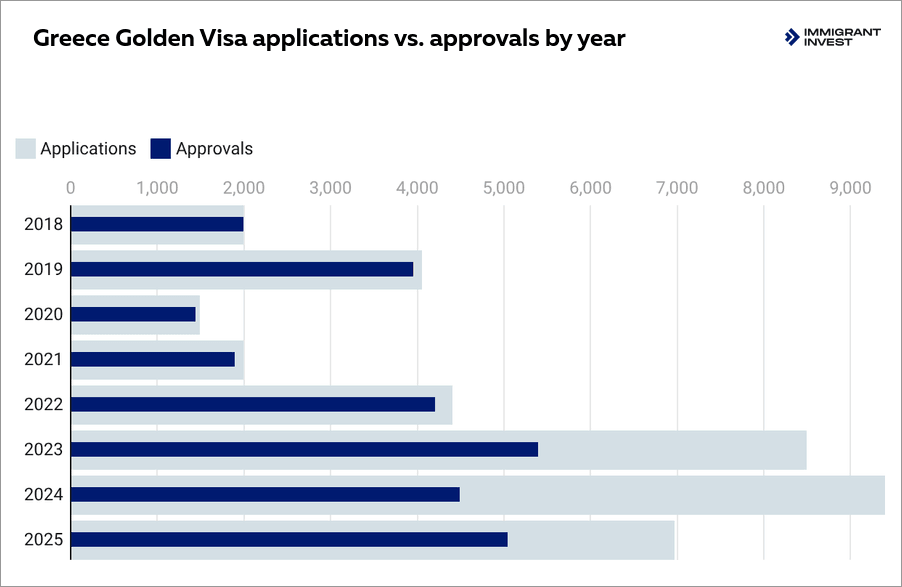
After 10 years in operation, the Greece Golden Visa continues to process a high volume of applications
Challenges of living in Greece
Living in Greece offers clear lifestyle advantages, but there are also practical limitations to consider before relocating.
Salaries in Greece are generally lower than in many countries in the European Union, which may affect those planning to rely on local employment. Bureaucratic processes can also be slow, particularly when dealing with public services, permits, or administrative procedures.
Infrastructure and service quality vary by region. While Athens and larger cities offer international schools, private healthcare, and reliable services, smaller towns and islands may have limited access to these, especially outside the tourist season.
The pace of life, often seen as an advantage, may also require adjustment. Administrative processes can take time, and timelines are not always predictable, especially for those used to more structured systems.
Overall, Greece tends to suit those who prioritise lifestyle and flexibility, while those expecting high income levels or highly structured systems may need to adapt.
How to move to Greece through the investment pathway
Greece offers non-EU nationals the opportunity to obtain residence by investment under the Greece Golden Visa programme[5]. It is one of the most established options in the European Union and is often considered by investors looking for both flexibility and access to a Mediterranean lifestyle.
Through the real estate purchase
The most common route is real estate, with minimum investment thresholds depending on the region and type of property. Applicants may qualify through the following real estate routes:
- €250,000 for a property in need of full renovation;
- €250,000 for a listed historic property, provided the required works are completed by the first residence permit renewal, 5 years after approval;
- €400,000 for a single in provincial areas;
- €800,000 for a single ready property in prime locations, including Athens and its suburbs, Thessaloniki, Mykonos, Santorini, and islands with a population of over 3,100.
Real estate remains one of the most widely used investment routes. In the first half of 2024, around 85,000 property transactions were completed in Greece. Continued demand from international buyers, together with a strong tourism sector, supports both long-term and short-term rentals, while property prices have been showing steady growth.
Examples of real estate property in Greece


Greece, Athens
€720,000+
Cosy and stylish apartments in modern style, Glyfada, Athens
 98 m²
98 m² 2
2  2
2 
Greece, Athens
€1,185,000+
Luxury apartments, Varkiza, Athens
207 m²4 4 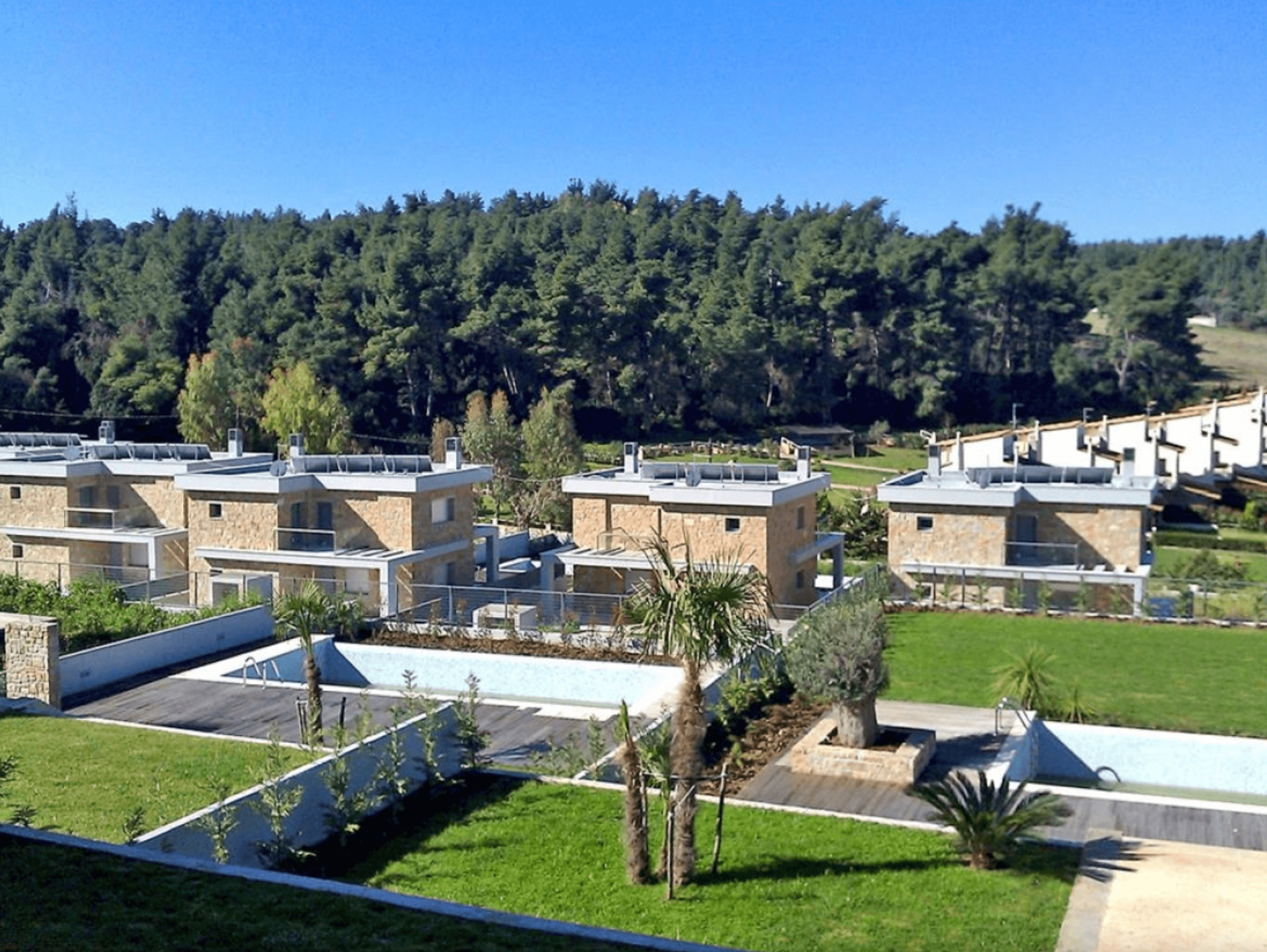
Greece, Kassandra
€505,000+
Modern villa, Sani, Kassandra
170 m²4 3 Through the fund purchase and other options
For those who prefer financial instruments, such as investment in funds, bank deposits, government or corporate bonds, and capital contributions to Greek companies. These routes require a higher investment threshold but may suit applicants who are not interested in managing property or who prefer a more passive approach.
General requirements
To qualify for a Greece Golden Visa, an investor must be at least 18 years old, have no criminal record and no ongoing legal cases and confirm that the investment funds come from a legal source.
The programme allows the inclusion of family members, such as:
- a spouse or registered partner;
- children under 18;
- dependent children aged 18 to 21 enrolled in full-time education;
- parents of both the investor and their spouse.
If applying with a partner, the relationship must be formalised through a cohabitation agreement registered in Greece for the application to be accepted.
Step-by-step procedure of obtaining Greece Golden Visa for expats
Based on the experience of Immigrant Invest, obtaining the Greece Golden Visa usually takes a minimum of 4 months. Below is a step-by-step outline of the typical process when buying property.
1 day
Preliminary Due Diligence
A certified Anti-Money Laundering officer conducts a preliminary review to identify any potential issues. This helps keep the risk of Golden Visa rejection below 1%.
A certified Anti-Money Laundering officer conducts a preliminary review to identify any potential issues. This helps keep the risk of Golden Visa rejection below 1%.
1+ weeks
Selecting a fund or an investment property
Immigrant Invest’s real estate specialists assist applicants in selecting properties that match their financial objectives and lifestyle needs. Thanks to direct partnerships throughout Greece, the Immigrant Invest team provides access to a curated portfolio of over 200 approved investment properties available for immediate purchase.
Immigrant Invest’s real estate specialists assist applicants in selecting properties that match their financial objectives and lifestyle needs. Thanks to direct partnerships throughout Greece, the Immigrant Invest team provides access to a curated portfolio of over 200 approved investment properties available for immediate purchase.
1+ weeks
Preparing documents
The investor provides the necessary paperwork and issues a power of attorney, allowing the legal team to act on their behalf in Greece. Attorneys handle the completion of official forms and the preparation of all required documents, including financial and personal records.
The investor provides the necessary paperwork and issues a power of attorney, allowing the legal team to act on their behalf in Greece. Attorneys handle the completion of official forms and the preparation of all required documents, including financial and personal records.
Up to 2 weeks
Obtaining a tax number in Greece
A Greek tax number, AFM, is required for major transactions, such as purchasing real estate. Lawyers handle the registration process and submit the necessary documents, with the tax number usually issued within 2—10 business days.
A Greek tax number, AFM, is required for major transactions, such as purchasing real estate. Lawyers handle the registration process and submit the necessary documents, with the tax number usually issued within 2—10 business days.
4+ weeks
Property or fund units purchase
The process starts with a preliminary agreement and a 10% deposit. Lawyers then draft the final purchase contract, which is signed before a notary.
This step can be completed either by the investor or by their lawyer acting under the power of attorney. Once the contract is officially registered, the investor receives translated and notarised copies of all property documents.
The process starts with a preliminary agreement and a 10% deposit. Lawyers then draft the final purchase contract, which is signed before a notary.
This step can be completed either by the investor or by their lawyer acting under the power of attorney. Once the contract is officially registered, the investor receives translated and notarised copies of all property documents.
1 day
Applying for a residence permit
After the investment requirement is met, the next step is to submit the residency application. This is done online through Greece’s official migration portal.
Within approximately 1 week, applicants receive confirmation certificates that permit legal residence in Greece for up to 1 year while their residency application is under review.
After the investment requirement is met, the next step is to submit the residency application. This is done online through Greece’s official migration portal.
Within approximately 1 week, applicants receive confirmation certificates that permit legal residence in Greece for up to 1 year while their residency application is under review.
Within 6 months
Submission of biometrics
All applicants must attend an in-person appointment to provide their biometric data. These appointments are scheduled within 1 to 2 weeks of submitting the application.
All applicants must attend an in-person appointment to provide their biometric data. These appointments are scheduled within 1 to 2 weeks of submitting the application.
3+ months
Receiving residence permit cards
Once the application is approved, residence permit cards can be collected either in person or by a legal representative. To obtain the cards, the family must present their passports and return the original application confirmation certificates.
Once the application is approved, residence permit cards can be collected either in person or by a legal representative. To obtain the cards, the family must present their passports and return the original application confirmation certificates.
Taxes when living in Greece as a foreigner
Greece combines a relatively high quality of life with flexible tax regimes, which makes it attractive for expats in Greece and international residents considering long-term relocation.
Tax residency and obligations
Taxation is a key aspect of living in Greece as a foreigner. An individual becomes a tax resident if they spend more than 183 days per year in the country.
Greece offers several tax regimes that can be relevant for expats depending on their income structure and investment profile.
Special tax regimes
One option is a 7% flat tax on foreign income, including dividends, interest and rental income earned abroad. It applies for up to 15 years and is paid annually in a single instalment.
Another option is the non-domicile regime, designed for individuals with substantial foreign income. Instead of taxing income, it applies a fixed annual tax of €100,000 on foreign-source income. To qualify, applicants must invest at least €500,000 in Greece and meet non-residency requirements.
Both regimes can significantly reduce the tax burden for expats in Greece, depending on their financial situation.
Standard taxation
If no special regime applies, individuals are taxed under the standard progressive system, with rates ranging from 9 to 44% on worldwide income.
Rental income is taxed separately at rates between 15 and 45%. Other taxes include:
- 22% corporate income tax
- 0 to 10% solidarity contribution
- 1 to 40% inheritance and gift tax
- 3% property transfer tax
- 24% standard VAT, with reduced rates of 13% and 6% for certain goods and services
International tax considerations
For foreigners from countries like the United States, tax obligations may continue in their home country. However, double taxation agreements help avoid paying tax twice. For example, US citizens can offset Greek taxes through foreign tax credits.
Where to live in Greece
The choice of location in Greece depends on lifestyle, budget, and long-term plans. Expats in Greece can choose between large cities, islands, and mainland coastal areas, each offering different advantages.
Athens
Athens is the main entry point for expats and investors. It offers the widest choice of international schools, private healthcare, and year-round infrastructure. Central areas such as Kolonaki and Glyfada are popular among foreigners, while the suburbs provide more space and lower prices.
For those planning long-term residence or frequent stays, Athens is the most practical option. It also has the most active real estate market, which is relevant for Golden Visa investors.
Thessaloniki
Thessaloniki is the second-largest city and offers a slower pace of life compared to Athens. It combines urban infrastructure with lower living costs and a strong cultural scene. The city is often chosen by expats who want a balance between affordability and access to services, without the intensity of the capital.
Greek islands
Islands such as Crete, Corfu, and Rhodes are among the most popular choices for expats. They offer sea access, mild climate, and a more relaxed lifestyle. However, infrastructure can vary. Larger islands like Crete have hospitals, universities, and year-round services, while smaller islands may be more suitable for seasonal living or retirees.
Mainland coastal areas
Regions such as the Peloponnese and parts of Central Greece provide access to the sea at a lower cost than the islands. These areas are increasingly popular among expats looking for space, privacy, and lower property prices.
They can be suitable for long-term living, especially for retirees or remote workers, although access to international schools and services may be more limited.
5 key facts about living in Greece for expats and investors
- Greece is suitable for expats with income from abroad, as lower living costs allow them to maintain a higher standard of living compared to relying on local salaries.
- The Greece Golden Visa allows investors to obtain and maintain residence without a minimum stay requirement, making it suitable for those who plan to live in the country part-time or gradually relocate.
- The main advantage of living in Greece is the lifestyle, including climate, sea access, and a slower pace of life, while practical factors such as bureaucracy and uneven public services should also be considered.
- The choice of location significantly affects daily life, as Athens provides better infrastructure, islands offer a more relaxed environment, and mainland regions combine lower costs with fewer services.
- Special tax regimes, including a flat 7% rate for retirees and non-dom options for high-net-worth individuals, can reduce the overall tax burden depending on the applicant’s financial situation.
Immigrant Invest is a licensed agent for citizenship and residence by investment programs in the EU, the Caribbean, Asia, and the Middle East. Take advantage of our global 15-year expertise — schedule a meeting with our investment programs experts.