







Greece pairs everyday liveability — sea, sun, safe cities — with EU stability and Schengen mobility. Practicalities match the appeal: filings are increasingly digital, biometrics are routine, and fast internet is standard, making it easy to work, study, or run a business.
Choosing the right route to residency in Greece comes down to three levers: where income comes from, whether there is an employer, and how much capital is available.
This guide matches those inputs to the main residency pathways and explains what to prepare at each step.
Overview of Greece residence options for non-EU nationals
Greece offers accessible and flexible residency options that continue to attract newcomers. The impact is clear: in 2024, over 600,000 third-country nationals were resident in Greece[1].
Main residence routes
Applicants can choose from several legal bases, depending on their profile:
- Employment, including for highly qualified workers.
- Digital Nomad Visa for remote professionals.
- Financial independence for those with income from abroad.
- Family reunification.
- Marriage to a Greek citizen.
- Studies.
- Asylum, where protection grounds apply.
- Retirement.
The Greece Golden Visa: investment-led stability
For those seeking a fast-track, low-commitment option, the Greece Golden Visa stands out:
- 5-year residence permit, immediately classified as long-term under Greek law;
- no minimum stay required — unlike other permits that often presume 183-day presence;
- eligibility starts from €250,000 investment in real estate, regulated funds or bank deposits;
- nearly 50,000 Golden Visas issued since the launch in 2013, including for family members;
- no language or civics exam required to maintain status.
By contrast, standard routes only unlock similar stability after 5 years of continuous residence and success in integration exams.
Greek residence permit types at a glance

Purchasing property to obtain Greece residency
Buying property in Greece is a clear route to Golden Visa residency. In 2024, 28,694 residential transfer contracts were registered, and foreign inflows into real estate reached €2.75 billion[2] — more than 10 times higher than a decade ago[3].
Real estate now represents 54.2% of Greece’s total FDI, placing the country alongside Southern Europe’s most attractive markets[4].
Foreign demand for Greek property remains strong, with notable interest from Israel, Turkey, Bulgaria, the UK, France and the Netherlands. For instance, more than 17,000 British nationals now live in Greece, attracted by the climate, relaxed pace of life, and the opportunity to get a long residence permit by investment.
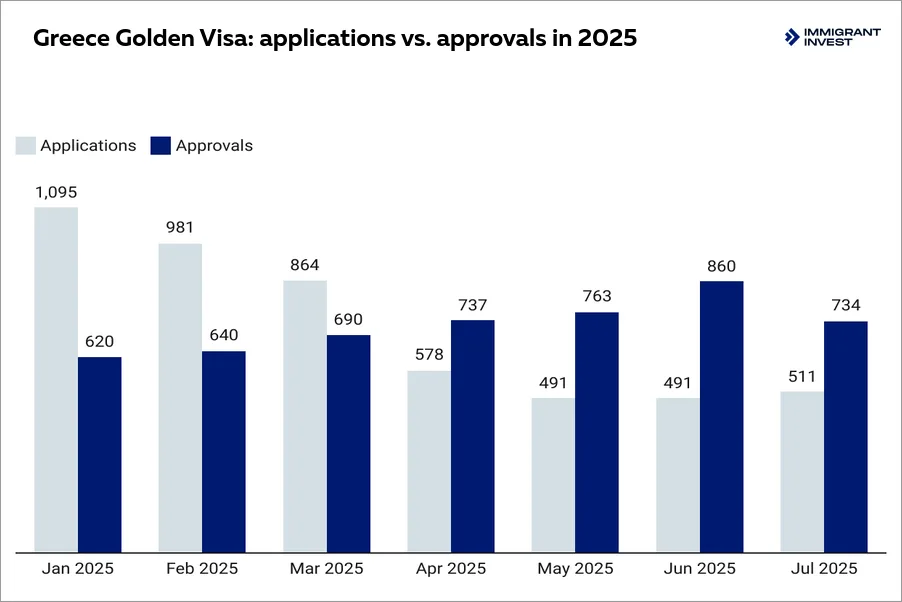
In the Golden Visa stream, China, Turkey, Lebanon, and the UK are the top nationalities submitting applications[6].
€250,000 renovation property option
The €250,000 threshold applies only to specific types of renovation projects. The investment must be made in a single property, regardless of its size or location within Greece.
Two property categories qualify:
- Conversion of unused commercial property. One may invest in a commercial or industrial building that has been vacant for over 5 years, provided it is fully converted into residential use. A formal change-of-use permit must be obtained, and all renovation work must be completed before submitting the Golden Visa application.
- Restoration of listed historic buildings. One may also invest in a designated heritage property undergoing full restoration. The renovation must be finished no later than the first residence permit renewal, which takes place 5 years after initial approval.
€400,000 ready-to-move and off-plan property option
The €400,000 threshold applies to real estate in most areas of Greece, excluding high-demand zones. Eligible properties may be purchased on the primary or secondary market, including new builds, off-plan projects, recently completed units, or properties under construction.
Eligibility conditions:
- property must be located outside Athens, Thessaloniki, Santorini, Mykonos, and islands with over 3,100 residents;
- may be residential or commercial;
- must have a minimum size of 120 square metres.
The full €400,000 must be invested in a single property, not across multiple smaller assets.
€800,000 premium location property option
The €800,000 threshold applies to properties located in high-demand zones of Greece:
- Region of Attica, including Athens and its suburbs;
- Thessaloniki;
- Mykonos;
- Santorini;
- any island with over 3,100 residents.
Eligibility conditions are the same as for the €400,000 option. Investors may buy on the primary or secondary market. The property may be either residential or commercial, must have a minimum size of 120 square metres, and the full €800,000 must be invested in a single unit.
Investment real estate in Greece


Greece, Athens
€720,000+
Cosy and stylish apartments in modern style, Glyfada, Athens
 98 m²
98 m² 2
2  2
2 
Greece, Athens
€1,185,000+
Luxury apartments, Varkiza, Athens
207 m²4 4 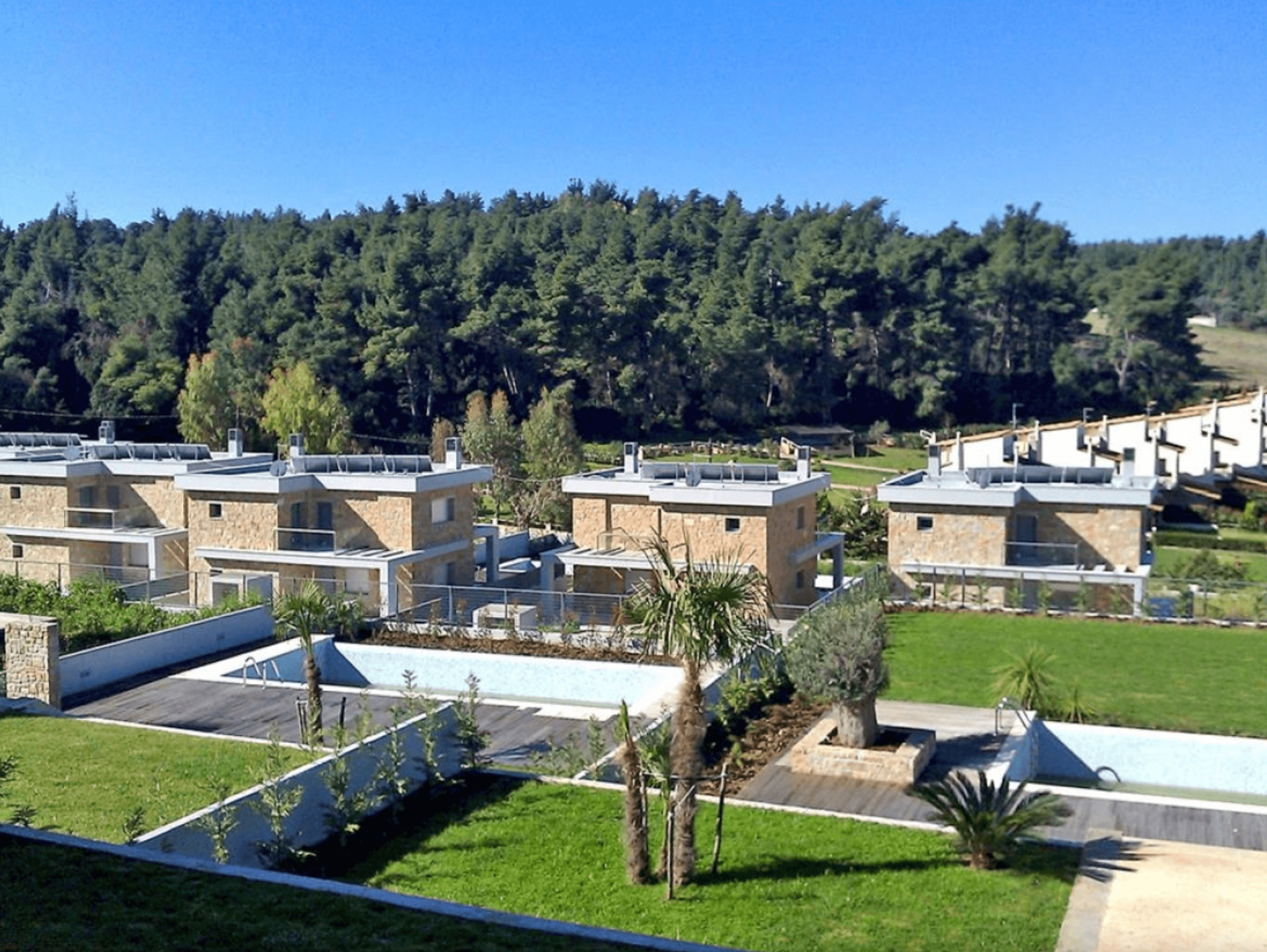
Greece, Kassandra
€505,000+
Modern villa, Sani, Kassandra
170 m²4 3 Property use rules
Ownership rules. Ownership of the property may be structured either directly in the investor’s name or through a legal entity, provided the investor holds 100% of the company shares.
Rental rules. Under the Golden Visa programme, properties cannot be used for short-term rentals such as Airbnb. Only long-term leases are permitted. Breaching this rule may result in a €50,000 fine and cancellation of the residence permit.
An exception applies to properties purchased before August 31st, 2024, which may continue to be let on a short-term basis.
Exit rules for property investors
To maintain a Golden Visa, the qualifying property must remain in the investor’s ownership. If the property is sold before citizenship is obtained, the residence permit will lapse unless another eligible property is acquired.
The property may be sold freely without affecting immigration status once the investor has held the permit for at least 5 years and obtained long-term residency, or at least 7 years and obtained Greece citizenship.
Key advantages of investing in Greek real estate
Investors enjoy the following benefits of buying property in Greece:
- rental income: yields of 4.5—10% on long-term leases;
- property price growth: 7—9% annually;
- personal use flexibility: option to occupy or rent out the property;
- tangible asset: direct ownership of physical real estate;
- asset replaceability: ability to sell and acquire another qualifying property during the holding period, preserving residency continuity.
Trusted by 10,000+ investors
Check your eligibility for the Greece Golden Visa
Buying investment fund units as a way to get Greek residency
The fund route offers an alternative to buying property for obtaining the Greece Golden Visa. It allows an applicant to qualify by acquiring eligible fund units for €350,000 and holding them for at least 5 years. This structure suits investors who want exposure to Greece while delegating day-to-day management and compliance to regulated professionals.
Eligible fund categories for a €350,000 investment
Two fund types qualify:
- Mutual funds, limited to financial instruments such as Greek-listed shares, corporate and government bonds.
- Alternative Investment Funds, or AIFs, limited to Greek real estate.
Mandatory fund requirements
Each qualifying fund must meet all of the following requirements:
- hold a minimum net asset value of €3,000,000;
- be managed by an entity licensed by an EU-recognised capital markets authority;
- be domiciled in Greece or another EU member state;
- invest exclusively in Greece;
- appoint a Greek-based credit institution as custodian.
Exit rules for fund investors
To maintain residency, the investment must be held until the investor obtains long-term residency or citizenship, at 5 and 7 years, respectively. Withdrawing funds without first acquiring long-term residency or citizenship results in the loss of the residence permit.

Priscila Carvalho,
Investment Migration Expert
Sometimes a qualifying fund investment may dip below the statutory minimum due to market moves. That might cause understandable concern that the Golden Visa could be jeopardised.
In practice, under Greece’s Golden Visa programme, the residence permit is tied to making the required investment, not the asset’s current market value. A temporary decline does not trigger cancellation on its own. What matters is that the full amount was invested at application and the assets are retained for the 5-year holding period.
Key advantages of investing in Greek funds
Greek fund investments come with notable benefits:
- low threshold: entry at €350,000;
- fast-track route to residency: 4+ months;
- diversification: mitigates single-asset concentration risk;
- professional management: licensed managers provide hands-off oversight;
- simplified compliance: the fund handles reporting and paperwork, reducing the administrative burden.
Performance and strategy details — on request
Detailed information on strategy performance, yield expectations and specific risks is not publicly disclosed. Offering documents are available only on request and typically follow an expression of interest to an authorised representative, such as Immigrant Invest. At this point, the manager provides the regulated materials required for Due Diligence.
Placing a deposit in a Greek bank for residency
This route qualifies investors for the Golden Visa by placing capital on a fixed term with a Greek credit institution. It appeals to applicants who prefer a low-volatility, bank-based option over real assets.
Investment requirement — €500,000
A fixed-term deposit of at least €500,000 is required, held for a minimum duration of 1 year with a standing order in place for automatic renewal. To keep the residence permit, the investor must renew the deposit continuously for at least 5 or 7 years, depending on whether they intend to apply for long-term residency or citizenship.
The account can be opened with co-beneficiaries, including the investor’s spouse, civil partner, and blood relatives up to the second degree.
The credit institution issues certificates confirming the establishment and ongoing retention of the deposit, which serve as evidence of the investment to the authorities.
Key advantages of the bank account investment route
Opening a bank account under the Golden Visa programme brings several advantages:
-
interest yields: up to 1% annually;
-
simplicity: easy to arrange with standard bank KYC checks; no need for property searches, valuations, or notarial transfers;
-
high speed to residency: 4+ months;
-
low operational burden: nothing to manage day to day;
-
predictable income: fixed-term deposits pay interest at a known rate for the term.
Priscila Carvalho,
Investment Migration Expert
Golden Visa investors can change their qualifying investment — from property to a fund or bank deposit, and vice versa — without losing their Greek residence permit.
The change must be seamless: complete and evidence the new eligible investment before disposing of the original asset, so there is no gap in eligibility. Once the replacement meets all programme requirements, the permit remains valid and can be renewed as usual.
Step-by-step procedure for obtaining Greece residency by investment
Timeframes for obtaining a Greek residence permit vary by route. Real estate takes at least 6 months, while fund investments and bank deposits are faster, typically around 4 months. The step-by-step guide below — spanning document preparation to card issuance — is based on Immigrant Invest’s practical experience.
1 day
Preliminary Due Diligence
A background review confirms the applicant meets programme criteria, helping to reduce refusal risk to under 1%.
A background review confirms the applicant meets programme criteria, helping to reduce refusal risk to under 1%.
1+ weeks
Document preparation
The Immigrant Invest legal team completes government forms, gathers financial and personal documentation, and arranges a power of attorney to authorise representation in Greece.
The Immigrant Invest legal team completes government forms, gathers financial and personal documentation, and arranges a power of attorney to authorise representation in Greece.
Up to 1 week
Getting a tax number in Greece
The legal counsel files for a Greek tax number with supporting documents. The tax number is required for major transactions such as property purchases or opening a bank account.
The legal counsel files for a Greek tax number with supporting documents. The tax number is required for major transactions such as property purchases or opening a bank account.
1+ months
Investment
The investor selects one of the eligible routes: acquiring units in a qualifying investment fund, placing a qualifying fixed-term deposit with a Greek credit institution, or purchasing real estate. The legal team prepares the evidence needed to verify the investment.
The investor selects one of the eligible routes: acquiring units in a qualifying investment fund, placing a qualifying fixed-term deposit with a Greek credit institution, or purchasing real estate. The legal team prepares the evidence needed to verify the investment.
1 day
Residence application
Once the investment is complete, the Golden Visa application is submitted online. A submission certificate is issued within about a week, allowing lawful stay in Greece for up to 1 year while the application is processed.
Once the investment is complete, the Golden Visa application is submitted online. A submission certificate is issued within about a week, allowing lawful stay in Greece for up to 1 year while the application is processed.
Within 6 months
Biometric data submission
Applicants attend a biometrics appointment, typically scheduled 1—2 weeks after filing. An entry visa may be required to travel for this step.
Applicants attend a biometrics appointment, typically scheduled 1—2 weeks after filing. An entry visa may be required to travel for this step.
2+ months
Residence permit card issuance
Indicative production times: around 2 months for fund and bank deposit routes; approximately 3—6 months for property purchases. Cards may be collected in person or by an authorised lawyer.
Indicative production times: around 2 months for fund and bank deposit routes; approximately 3—6 months for property purchases. Cards may be collected in person or by an authorised lawyer.
Proving passive income to get residency in Greece
Greece offers a residence route for financially independent persons, FIPs, who can show stable income from outside Greece. It suits applicants with passive earnings who do not intend to access the local labour market.
Income threshold — €3,500 per month
The minimum monthly income required is €3,500. If family members accompany the main applicant, the requirement increases by 20% for a spouse or cohabiting partner and by 15% for each dependent child[7].
Example calculations:
- single applicant — €3,500+ per month;
- married couple — €4,200+ per month;
- single parent with a child — €4,025 per month;
- family of three — €4,725 per month;
- family of four — €5,250 per month.
The permit is issued for 2 years initially and may be renewed for an additional 2 years, provided the financial conditions continue to be satisfied.
Work rights and perks for financially independent persons in Greece
Employment or business activity in Greece is not permitted under this permit. After 5 years and the acquisition of long-term residence, all family members gain the right to work in Greece.
The financially independent visa offers several benefits:
- multiple income sources accepted: pensions, dividends, rental yields from abroad;
- retiree incentive: a 7% flat tax on foreign pension income for up to 15 years[8].

Greece is well-suited to motorhome travel, with numerous official campsites nationwide; hiring a family motorhome costs €140—250 per day
Greece residence permit for digital nomads
Greece blends sunlit coasts and lively cities with practical advantages for remote work, making it a natural base for digital nomads. Fibre-optic internet is widely available, and 5G covers 99% of the population, enabling work from almost anywhere.
Financial threshold — €3,500 per month
To qualify for the Greece Digital Nomad Visa, applicants must prove income from sources outside Greece and secure accommodation by renting or purchasing a home.
A minimum net monthly income of €3,500 is required. If accompanied by a spouse or cohabiting partner, the threshold increases by 20%, plus 15% for each dependent child.
The Digital Nomad Residence Permit is granted for up to 2 years initially and can be renewed in 2-year increments.
Work rights and perks for digital nomads in Greece
Applicants must work for an employer registered outside Greece or operate as freelancers with clients based abroad. Paid work for Greek companies or clients in the local market is prohibited under this status.
Digital nomads enjoy the following benefits of their residence permit:
- 50% reduction in personal income tax for the first 7 years of residency[9];
- 1-year entry visa before acquiring residency;
- no labour-market test, job offer or company-sponsorship required.

Digital nomads looking to escape the hectic pace can settle in the traditional village of Koroni, where long-term rents for a 100 m² apartment start at just €350 per month
Other ways to become a Greek resident
Not every path to Greek residency requires investment. Greece also provides a range of alternative routes tailored to different personal circumstances — from professional opportunities to family ties and education. These options expand access to Greek residency beyond investors, reflecting the country’s commitment to supporting workers, families, students, and refugees alike.
Employment in Greece
Before hiring a third-country national, the employer must secure authorisation from the Decentralised Administration and demonstrate ability to meet the contract wages. The employment contract must run for at least 1 year[10].
Minimum pay levels apply by role. Starting April 1st, 2025, the thresholds are[11]:
- €880 per month for white-collar employees — professional, managerial or administrative roles;
- €39.30 per day for blue-collar workers — manual or skilled physical work.
The residence permit is issued for an initial 2 years and is then renewable in 3-year periods, subject to continuing compliance.
Key advantages for employees include:
- contract-linked validity with flexible durations;
- simplified renewals without a new contract;
- full national social-security coverage.
Blue Card for highly qualified activity
The EU Blue Card provides a route for highly skilled non-EU nationals to take up employment and residence in Greece. Applicants qualify either with a recognised higher education diploma relevant to the role or with at least 5 years of professional experience equivalent to higher education level and relevant to the duties[12].
The minimum gross salary is €31,919, which is 1.6 times the national average.
The permit is granted for 2 years and can be extended for a further 3 years. If the employment contract is shorter than 2 years, the Blue Card is issued for the contract duration plus 3 months, capped at the 2-year maximum.
Key benefits for highly qualified workers in Greece:
- option to move to another EU Member State after 18 months to take up highly qualified work under that state’s Blue Card rules, without additional visas or permits;
- ability to apply in Greece without first obtaining a long-term national visa;
- equal treatment in work and social rights.

In 2024, 119,517 employment-based residence permits were in force, and 58 EU Blue Cards were issued in Greece
Family reunification
Foreign nationals who have held a Greek residence permit for at least 2 years may apply to reunite with close family members. Eligible relatives include a spouse aged 18 or over and unmarried minor children[13].
Family reunification permits are issued for the same duration as the sponsor’s permit. For renewal, authorities require confirmation of the family relationship, as well as evidence of the sponsor’s tax compliance and social security status. Family members gain access to employment upon the first renewal of their permits.
Marriage to a Greek citizen
A foreign national who intends to marry a Greek citizen should first enter Greece on a tourist visa and file a marriage application at the local municipality. Once the marriage is registered and a certificate issued, the foreign spouse becomes eligible to apply for a residence permit.
Authorities require proof that the marriage is genuine. The couple may be invited to an interview and asked questions about their shared life to verify the relationship.
The residence permit is valid for 5 years. After this period, the foreign spouse may apply for long-term residence.
A foreign spouse of an EU citizen in Greece is entitled to:
- right to access the labour market;
- eligibility for citizenship after 3 years[14];
- right to an independent permit after divorce, if the marriage lasted at least 3 years;
- family reunification rights.
Education
Applicants must present proof of admission and show sufficient means to support themselves during studies, with at least €400 per month held in a bank account.
The permit is issued for the length of the studies. After 5 years of lawful residence, students may qualify for long-term resident status, typically after completing a master’s degree.
Benefits for students include:
- part-time work rights — up to 15 hours per week.
- broad eligibility — residence is possible not only for university studies but also for vocational training, language courses, music schools, pilot education, and the Athonias Academy.

QS World University Rankings 2026 lists 3 Greek universities in the global top 500, including the National and Kapodistrian University of Athens[15]
Asylum
Refugee status in Greece may be granted to individuals who cannot return to their country of origin because of a well-founded fear of persecution on the grounds of race, religion, nationality, membership of a particular social group or political opinion.
A refugee residence permit is issued for 3 years and is renewable. Spouses and children are also eligible for residence permits.
Refugees get the right to work, bring family members, and are eligible for citizenship after 3 years if recognised as stateless by the Greek authorities[16].
In 2024, 39,271 refugee statuses were granted at first instance in Greece[17].
Special provisions for EU citizens
Citizens of the EU, EEA and Switzerland, along with their family members, have an automatic right to live in Greece. No special visa, residence permit or investment is required. For stays over 90 days, registration of residence is necessary.
Registration is handled by the local Aliens and Immigration Department or a Citizens’ Service Centre and is completed within 30 days of filing.
EU citizens with Greek residency have the following rights and entitlements:
- right to work, study, or retire in Greece;
- access to public services on the same terms as Greek citizens;
- eligibility for citizenship after 3 years[18].
Long-term resident status and citizenship in Greece
For many foreigners, the ultimate goal of moving to Greece is not only to obtain a residence permit but also to secure a stable, long-term future in the country. Greek law provides two milestones on this path: long-term resident status and citizenship. Both statuses open wider rights and freedoms: from full access to the labour market to participation in European civic life.
Stay requirement
Eligibility for long-term residence arises after 5 years of lawful residence in Greece. Short absences are allowed during this period, provided they do not exceed 6 months at a time or 10 months in total across the 5 years[19].
Greek citizenship is available after 7 years of living in Greece, starting from the first residence permit. The law does not set a fixed annual day-count. In practice, applicants should maintain continuous residence and avoid long absences. The waiting time for a decision is 2—4 years.
Integration requirement
Applicants for long-term residency must show A2-level Greek and a basic understanding of the country’s history and culture[20].
Citizenship applicants must pass the Certificate of Knowledge Adequacy for Naturalisation, which assesses language at B1 level and knowledge of geography, history, culture and political institutions of Greece — or hold an equivalent certification published by the Ministry of Interior[21].
Income requirement
Applicants for long-term residence must demonstrate an annual income at least equal to the minimum wage, which is €10,560 in 2025.
For citizenship applicants, no fixed income threshold is set in law. Authorities consider overall economic and social integration, including tax filings and lawful resources.
Benefits
Greek long-term residents and citizens benefit from the following:
- full access to the Greek labour market, including self-employment and company formation;
- durable, lifelong status;
- no ongoing mandatory stay requirement;
- right to live and work anywhere in the EU, to vote and stand in European Parliament elections under EU rules — for Greek citizens only.
Validity
The long-term status does not expire, but the residence card must be renewed every 5 years. After obtaining citizenship, the passport must be renewed every 10 years.
Which Greece residence permit to choose?
- The Greece Golden Visa is a compelling route to residency, offering a 5-year renewable permit, no minimum-stay requirement, potential capital growth, and family inclusion.
- For rental income, flexibility and direct ownership, the property purchase route under the Golden Visa fits best. The minimum is €250,000 for properties bought for renovation; for other properties, higher thresholds of €400,000 or €800,000 apply.
- Fund investment suits those who prefer licensed managers and diversification, with a minimum investment of €350,000.
- Bank deposit is ideal for a low operational burden and predictable income, with a higher threshold of €500,000.
- If speed is the priority, a fund investment or a bank deposit offers faster processing, at around 4 months.
- Beyond the Golden Visa, students, digital nomads, financially independent persons and others can obtain residence in Greece through their respective permit categories.
Immigrant Invest is a licensed agent for citizenship and residence by investment programs in the EU, the Caribbean, Asia, and the Middle East. Take advantage of our global 15-year expertise — schedule a meeting with our investment programs experts.
Find out if you qualify for the Greece Golden Visa
- Master the residency process
- Get expert tips and documents
- Estimate costs accurately
 Trusted by 10,000+ investors
Sources
- Source: Asylum and Migration Overview 2024 by Eurostat
- Source: Οικονομικός Ταχυδρόμος, a Greek business and economics news outlet, 4 May 2025
- Source: IEFIMERIDA, a Greek online news portal, 21 May 2025
- Source: Kathimerini, Greece’s daily newspaper, 8 October 2024
- Source: To Vima, a long-running Greek newspaper, 4 June 2024
- Source: Schengen News, 4 December 2024
- Source: Greece, Law 5038/2023 “Migration Code”, Government Gazette A’ 81/01.04.2023
- Source: Article 5B of LAW NO. 4172/2013 (ITC)
- Source: Article 5C of LAW NO. 4172/2013 (ITC)
- Source: Official Website of the European Union
- Source: The Hellenic Republic, Ministry of Labour and Social Security
- Source: EU Immigration Portal
- Source: EU Immigration Portal
- Source: The Hellenic Ministry of Interior website, simplified instructions on the acquisition of Greek citizenship
- Source: QS World University Rankings 2026
- Source: The Hellenic Ministry of Interior website, simplified instructions on the acquisition of Greek citizenship
- Source: Asylum Statistics 2024 by Refugee Support Aegean
- Source: The Hellenic Ministry of Interior website, simplified instructions on the acquisition of Greek citizenship
- Source: EU Directive 2003/109/EC (Article 4)
- Source: Ministry of Migration & Asylum
- Source: The Ministry of Interior